Weighted Lap Pad Benefits: Who They Help and How
Weighted lap pads provide deep pressure input during seated tasks. Learn who benefits most, how they work, and how to choose the right one.

The DPS Editorial Team
Editorial Team ·
📖 Table of Contents
Affiliate Disclosure: As an Amazon Associate I earn from qualifying purchases. Some links on this page are affiliate links - if you buy through them, we receive a small commission at no extra cost to you. This never influences which products we recommend. Full disclosure policy
Weighted Lap Pad Benefits: Who They Help and How
Last Updated: May 25, 2026 | Author: The DPS Editorial Team
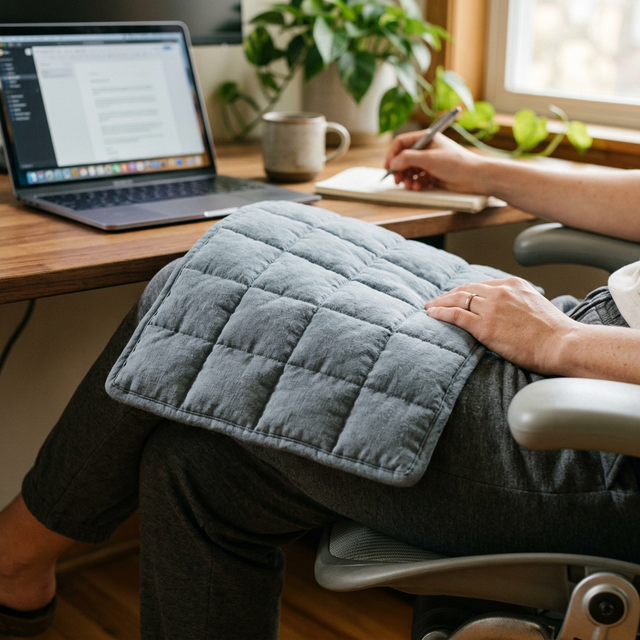
Weighted blankets get all the attention. Weighted lap pads do the same thing in a smaller package, and for certain situations, they’re actually the better tool. A lap pad sits across your thighs, delivering concentrated deep pressure input to the large muscles of the upper legs. No setup, no commitment to lying down, no temperature buildup. Just place it on your lap and get to work.
OTs have been using weighted lap pads in schools and clinics for decades. They’re increasingly popular with adults, too, especially people working at desks, attending meetings, or managing anxiety in settings where a full weighted blanket isn’t practical.
This guide breaks down who benefits from weighted lap pads, how the mechanism works, and what to look for when buying one.
TL;DR: Weighted lap pads deliver deep pressure stimulation to the quadriceps and hip flexors, activating proprioceptive receptors that promote calm and focus. Research on deep pressure tools shows reduced anxiety, improved attention, and lower cortisol. Lap pads are best for seated tasks (desk work, meetings, therapy, car rides) and are the most portable form of weighted deep pressure.
How Weighted Lap Pads Work
The mechanism is straightforward. The weight of the pad (typically 2-5 lbs) presses down on your upper thighs. Your quadriceps and hip flexors contain dense clusters of proprioceptive receptors, sensory neurons that detect pressure, stretch, and position. When the pad compresses these muscles, the receptors send signals through the spinal cord to the brainstem.
The brainstem responds by increasing parasympathetic activity: heart rate slows, cortisol decreases, and serotonin production ramps up. A 2008 study by Mullen et al. in Occupational Therapy in Mental Health documented this shift, finding that 63% of participants reported lower anxiety during deep pressure application and that the calming effect persisted after the pressure was removed.
The thighs are an effective target for this input because the muscle mass is large enough to engage many proprioceptors simultaneously, and the seated position keeps the pad stable without requiring hands to hold it in place.
For a deeper look at the science, see our guide to the science of deep pressure stimulation.
Who Benefits from Weighted Lap Pads
Children with Autism
Weighted lap pads are a staple in OT-guided sensory diets for autistic children. They’re used during:
- Circle time and classroom instruction
- Desk work and writing activities
- Transitions between activities
- Car rides (a common source of sensory overwhelm)
- Waiting rooms and appointments
The pad provides a predictable, constant input that helps the child’s nervous system organize incoming sensory information. Many teachers and parents report improved attention span and reduced fidgeting during pad use. Unlike a weighted vest, the lap pad doesn’t restrict movement and can be applied and removed without assistance.
For more on sensory tools for autism, see our deep pressure therapy autism guide.
Children and Adults with ADHD
The ADHD brain seeks stimulation. When the environment doesn’t provide enough, the nervous system creates its own through fidgeting, bouncing, tapping, or mentally drifting. A weighted lap pad provides steady background input that partially satisfies this need, reducing the drive to seek stimulation through less productive channels.
A study in the American Journal of Occupational Therapy (2012) found that deep pressure tools improved in-seat behavior by 18-25% in children with ADHD during classroom tasks. Adults with ADHD frequently report similar benefits during desk work, noting that a lap pad reduces the urge to get up, check their phone, or switch tasks.
Adults with Anxiety
Anxiety lives in the body as much as the mind. The tight chest, racing heart, and restless energy that accompany anxiety are autonomic nervous system responses. A weighted lap pad doesn’t address the cognitive content of anxious thoughts, but it directly counters the physical state by shifting the autonomic balance toward parasympathetic calm.
This makes lap pads particularly useful during:
- Work meetings that trigger social anxiety
- Waiting for medical appointments
- Managing anticipatory anxiety before events
- Any seated situation where anxiety shows up as physical restlessness
For more on deep pressure and anxiety, see our best weighted blankets for anxiety guide.
Elderly Adults
Weighted lap pads have found a growing application in elderly care settings. For seniors with dementia or Alzheimer’s, a lap pad can reduce agitation, fidgeting, and sundowning behaviors. The gentle weight provides comfort and grounding without the safety concerns that come with a full weighted blanket for less mobile adults.
The key advantage for elderly users: no risk of entrapment. Unlike a weighted blanket, a lap pad sits only on the thighs and can slide off easily if the person stands up.
For more on this topic, see our weighted blankets for elderly and seniors guide.
People in Wheelchairs
Wheelchair users who benefit from deep pressure have limited options. A weighted blanket is impractical during daily activities, and a weighted vest may interfere with posture supports or harnesses. A weighted lap pad delivers deep pressure to the legs without interacting with any other positioning equipment, making it one of the most accessible sensory tools for wheelchair users.
Weighted Lap Pad vs. Weighted Blanket: When to Use Which
Both tools use the same mechanism (gravity-driven deep pressure) but they serve different contexts:
| Factor | Weighted Lap Pad | Weighted Blanket |
|---|---|---|
| Typical weight | 2-5 lbs | 10-25 lbs (adults) |
| Coverage area | Upper thighs | Full body |
| Best setting | Desk, car, classroom, wheelchair | Bed, couch, resting at home |
| Portability | High - fits in a bag | Low - stays at home |
| Temperature impact | Minimal | Can cause overheating |
| Duration | Unlimited (most users) | Overnight or rest periods |
| Price | $20-$50 | $50-$250 |
| Setup | Place on lap | Spread over body |
If you’re choosing between the two, consider when and where you need deep pressure most. If your biggest challenge is focus during daytime tasks, start with a lap pad. If sleep is the primary issue, start with a weighted blanket. Many people end up using both.
For a thorough comparison of all weighted options, see our weighted blanket alternatives guide.
How to Choose a Weighted Lap Pad
Weight
The standard recommendation is 1-2 lbs for children and 3-5 lbs for adults. Unlike weighted blankets (10% of body weight), lap pads don’t follow a body weight formula because they cover a much smaller area. Start lighter and increase only if you don’t notice an effect.
Too heavy creates discomfort in the legs, especially during long sitting periods. If the pad is pressing uncomfortably into your thighs after 20 minutes, it’s too heavy.
Size
Lap pads typically measure 12” x 18” to 16” x 24”. Choose a size that covers both thighs without hanging over the sides of your legs. For children, smaller pads (around 12” x 16”) prevent the pad from sliding off smaller laps.
Fill Material
Glass beads: Heavy, smooth, and quiet. The most common fill for quality lap pads. Glass beads distribute weight evenly and don’t shift much during use.
Plastic poly pellets: Lighter and less expensive. Can be noisier when the pad is moved. Adequate for budget options but less premium feeling.
Steel shot beads: Very heavy for their volume. Used in compact, thin pads where you want maximum weight in minimum bulk. More expensive.
Rice or grain fills (DIY): Functional but temporary. Organic fills can develop mold or attract pests over time. Fine for testing the concept before buying a proper pad.
Cover Material
Soft, tactile covers add a second layer of sensory input. Minky (plush fleece) is the most popular choice for children. For adults in professional settings, look for covers with a neutral appearance, cotton, linen-look, or dark solid colors that blend with office environments.
Removable, washable covers are essential. The pad itself is often spot-clean only, so a machine-washable cover keeps things hygienic.
Top Weighted Lap Pad Recommendations
Harkla Weighted Lap Pad (5 lbs) - Soft minky cover, glass bead fill, designed specifically for sensory needs. The most popular option in OT communities. Harkla Weighted Lap Pad
SensaCalm Weighted Lap Pad - Available in 2, 3, and 5 lb options. Cotton cover, machine washable outer. Made in the USA. SensaCalm Lap Pad
Classroom Aid Weighted Lap Pad - Budget-friendly option for schools and clinics. 3 lb, polyester cover, suitable for younger children. Classroom Aid Lap Pad
Truhugs Weighted Lap Blanket - Slightly larger format (16” x 24”) for adults who want more coverage. 5 lb with bamboo-blend cover for temperature regulation. Truhugs Lap Blanket
Tips for Getting the Most from Your Lap Pad
Position it correctly. The pad should sit flat across both thighs, centered between your hip crease and your knees. Too far forward and it slides off; too far back and it presses into your hip joints.
Use it consistently. The regulatory benefits of deep pressure compound with routine. Using your lap pad at the same time each day (during morning desk work, during your commute, during evening reading) trains your nervous system to associate the weight with a focused, calm state.
Pair it with other tools. A lap pad works well alongside a compression garment for combined proprioceptive input. Some adults use both during high-demand work periods.
Keep one at each location. If you benefit from a lap pad at both home and work, having two saves you from forgetting to bring it. The cost of a second pad is modest compared to the daily benefit.
Frequently Asked Questions
How long can you use a weighted lap pad at one time?
Most people can use a weighted lap pad for as long as they’re seated without any issues. Unlike weighted vests (which OTs recommend limiting to 20-30 minute intervals), lap pads don’t compress the torso or restrict breathing. If you notice any numbness, tingling, or discomfort in your legs, remove the pad and take a break. For most users, continuous use during a full work session is perfectly fine.
Are weighted lap pads safe for toddlers?
Weighted lap pads can be used with toddlers under OT guidance, with appropriate weight (typically under 1 lb for very young children). The child should be able to push the pad off their lap independently. Never leave a weighted item on an unsupervised toddler. For children under 2, consult your pediatrician and OT before introducing any weighted sensory tool.
Can I make a weighted lap pad at home?
Yes. A simple DIY lap pad can be made by sewing a rectangular fabric pouch and filling it with rice, dried beans, or plastic poly pellets. Use channels or quilted sections to prevent the fill from shifting to one side. Rice-filled pads work well for testing whether a lap pad helps before investing in a commercial option. Replace rice-filled pads every few months to prevent mold growth.
Do weighted lap pads help with restless legs?
Many people with restless leg syndrome report that a weighted lap pad reduces the urge-to-move sensation, particularly during seated activities. The deep pressure input may provide the proprioceptive feedback that partially satisfies the restless sensation. This isn’t a substitute for medical treatment of RLS, but it can be a useful complementary tool. See our weighted blankets for restless leg syndrome guide for more on deep pressure and RLS.
The DPS Editorial Team
Editorial Team
The DeepPressureStimulation.com Editorial Team researches and writes about deep pressure stimulation, weighted blankets, and sensory tools. All content is based on peer-reviewed research, published clinical guidelines, and reputable health sources. Always consult a qualified healthcare provider before starting any new therapy.
Stay Informed, Stay Calm
Get science-backed articles on deep pressure therapy, weighted blankets, and sensory tools delivered to your inbox. No spam — just calm.
📬 No spam, ever. Unsubscribe anytime.