Deep Pressure Massage Techniques for Self-Regulation
Learn deep pressure massage techniques you can do yourself to reduce anxiety, calm sensory overload, and support nervous system regulation.

The DPS Editorial Team
Editorial Team ·
📖 Table of Contents
Affiliate Disclosure: As an Amazon Associate I earn from qualifying purchases. Some links on this page are affiliate links - if you buy through them, we receive a small commission at no extra cost to you. This never influences which products we recommend. Full disclosure policy
Deep Pressure Massage Techniques for Self-Regulation
Last Updated: May 26, 2026 | Author: The DPS Editorial Team
You don’t need a therapist’s table or a $120 session to get deep pressure massage. Your own hands, a tennis ball, and a wall can deliver the same mechanoreceptor activation that makes weighted blankets and compression garments effective — in under 10 minutes, anywhere you happen to be.
Deep pressure massage differs from relaxation massage in one critical way: it uses slow, sustained, firm pressure rather than light, flowing strokes. This distinction matters because the nervous system responds differently to each. Light touch activates C-tactile afferents (pleasant but alerting). Deep pressure activates Ruffini endings and Pacinian corpuscles (calming and regulating).
A 2005 meta-analysis by Field et al. in the International Journal of Neuroscience found that moderate-pressure massage reduced cortisol by an average of 31% and increased serotonin and dopamine by 28% and 31% respectively (Field et al., 2005). The key qualifier: moderate pressure. Light-touch massage didn’t produce the same neurochemical changes.
This guide covers the self-massage techniques that replicate deep pressure stimulation, the tools that help, and how to build a daily regulation practice.
TL;DR: Deep pressure massage uses firm, sustained force to activate mechanoreceptors that trigger parasympathetic responses — reducing cortisol by 31% and increasing serotonin by 28% (Field et al., 2005). Self-massage techniques targeting the hands, forearms, neck, and legs can be done in 5-10 minutes with no equipment. Tools like foam rollers, massage balls, and massage guns amplify the pressure. Consistency matters more than session length.
Why Deep Pressure Massage Works for Self-Regulation
Self-regulation is the ability to manage your arousal level — bringing yourself down when you’re overstimulated and up when you’re under-stimulated. For people with anxiety, PTSD, autism, ADHD, or sensory processing disorder, self-regulation doesn’t happen automatically. The nervous system gets stuck in sympathetic overdrive (anxiety, panic) or drops into hypo-arousal (shutdown, dissociation).
Deep pressure massage intervenes at the physiological level:
- Mechanoreceptors fire in response to sustained pressure on skin, fascia, and muscle
- Vagal tone increases as pressure signals travel through the vagus nerve to the brainstem
- Heart rate slows and blood pressure decreases
- Cortisol drops while serotonin and dopamine rise
- The autonomic nervous system shifts from sympathetic to parasympathetic dominance
This isn’t a metaphor or a relaxation technique that “works if you believe in it.” It’s a measurable neurological response to physical input. The same mechanism underlies weighted blankets, compression garments, and bear hugs.
For the full neuroscience, see our science of deep pressure stimulation guide.
Self-Massage Techniques for Regulation
These techniques require no equipment and can be done at a desk, in a car (while parked), on an airplane, or in a bathroom during a stressful event. Each one takes 2-5 minutes.
1. Palm and Hand Press
The hands contain dense concentrations of mechanoreceptors. Pressing firmly into the palm and between the fingers provides immediate calming input.
How to do it:
- Place the thumb of your opposite hand in the center of your palm
- Press firmly and hold for 5 seconds
- Release for 2 seconds, then press again
- Move the thumb to different spots across the palm — base of each finger, the meaty area below the thumb, the center
- Repeat for 2-3 minutes on each hand
- Apply enough pressure that you feel it in the muscles, not just on the surface
When to use: During meetings, in waiting rooms, on phone calls — completely invisible to others.
2. Forearm Roll
The forearm contains large proprioceptive muscle groups that respond strongly to deep pressure.
How to do it:
- Place your forearm on a desk or table, palm up
- Use the opposite hand (fingers wrapped around the forearm) to apply firm, slow pressure from wrist to elbow
- Move slowly — about 1 inch per second
- At tight or tender spots, hold steady pressure for 10-15 seconds
- Flip your forearm palm down and repeat on the extensor side
- 2-3 passes per forearm
When to use: At your desk during work breaks. Pair with a weighted lap pad for combined input.
3. Neck and Trapezius Squeeze
The neck and upper trapezius muscles carry tension from stress, poor posture, and sympathetic nervous system activation. Deep pressure here targets both muscle tension and sensory regulation.
How to do it:
- Reach your right hand across to your left trapezius (the muscle between your neck and shoulder)
- Squeeze firmly and hold for 10 seconds
- Release slowly
- Move to a slightly different spot on the same muscle and repeat
- Work from the base of the skull down to the shoulder
- Switch sides
- 3-4 squeezes per side, holding each for 10 seconds
When to use: At the onset of stress or anxiety. This is the technique most people do instinctively — rubbing their own neck when stressed. Make it intentional by slowing down and increasing the pressure.
4. Temple and Jaw Press
Jaw clenching is a hallmark of stress and anxiety. Deep pressure on the masseter (jaw muscle) and temporal region releases both muscular and nervous tension.
How to do it:
- Place three fingertips on each temple
- Apply firm, steady pressure (enough to feel the bone beneath) for 10 seconds
- Release for 5 seconds, then press again
- Move down to the jaw joint (just in front of the ear)
- Apply firm pressure and make small circular movements for 15 seconds
- Move to the masseter muscle (the big muscle that bulges when you clench your teeth)
- Press firmly and hold for 10 seconds, then release
- Repeat 2-3 times
5. Thigh and Quad Press
The quadriceps are the largest muscle group easily accessible for self-massage. Deep pressure on the thighs activates a large number of proprioceptors.
How to do it:
- While seated, place both hands flat on top of one thigh
- Press down firmly with your body weight through your hands
- Hold for 10 seconds
- Release, move hands slightly, and press again
- Work from just above the knee to the hip
- For deeper pressure, use a closed fist or the heel of your hand
- 3-4 presses per thigh
When to use: Seated at a desk, in a waiting room, during car rides (as a passenger). This mimics the effect of a weighted lap pad through active pressure.
Self-Massage With Tools
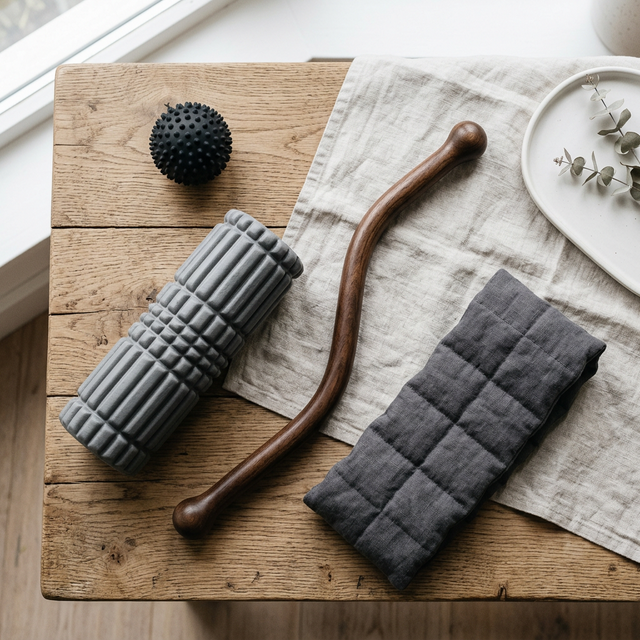
Your hands alone provide good pressure, but tools amplify the force and allow you to reach areas your hands can’t.
Foam Roller
A high-density foam roller provides intense deep pressure across large muscle groups. Rolling your back, legs, and glutes on a foam roller is one of the most effective self-administered deep pressure techniques available.
Key techniques:
- Upper back: Lie on the roller placed horizontally across your mid-back. Roll slowly up and down from mid-back to shoulders. Cross your arms over your chest for deeper pressure.
- IT band and outer thigh: Lie on your side with the roller under your outer thigh. Roll from hip to just above the knee.
- Glutes: Sit on the roller and shift weight to one side. Roll slowly across the glute muscles.
TriggerPoint GRID Foam Roller — Multi-density surface, compact size, durable construction.
Massage Ball (Lacrosse Ball or Tennis Ball)
A firm ball against a wall or floor provides precise, concentrated deep pressure to specific trigger points.
Key techniques:
- Upper back against wall: Place the ball between your back and a wall. Lean into it. Roll slowly to find tight spots. When you find one, hold pressure for 20-30 seconds.
- Foot rolling: Stand on the ball (hold a wall for balance) and roll it under your foot from heel to ball. Firm pressure activates plantar mechanoreceptors.
- Glute press: Sit on the ball on a firm chair. Shift weight to target specific spots.
Kieba Massage Lacrosse Balls (set of 2) — Firm, smooth, affordable.
Percussion Massage Gun
Massage guns deliver rapid, repetitive deep pressure at adjustable intensity. They’re the most powerful self-massage tool available and can replicate the pressure of a professional deep tissue massage.
Key techniques:
- Trapezius and shoulders: Medium speed, wide head attachment, 30-60 seconds per side
- Quads and hamstrings: Medium-to-high speed, round head, 60-90 seconds per muscle group
- Forearms: Low speed, small head, 30 seconds per forearm
Caution: Avoid the spine, neck front, joints, and bony prominences. Start at the lowest intensity and increase only as needed.
Bob and Brad Q2 Mini Massage Gun — Compact, quiet, portable, multiple head attachments.
For more on deep pressure tools, see our deep pressure massage tools guide.
Citation Capsule: Self-massage tools amplify the deep pressure effect beyond what hands alone can provide. Foam rollers target large muscle groups, massage balls provide precise pressure to trigger points, and percussion massage guns deliver rapid, adjustable-intensity deep pressure. All three tools activate the same mechanoreceptor pathways as clinical deep pressure interventions.
Building a Daily Practice
Consistency beats intensity. A 5-minute daily practice produces more sustained regulation than a 30-minute session once a week.
Morning routine (5 minutes)
- Foam roller: 2 minutes on upper back
- Hand press: 1 minute each hand
- Neck squeeze: 1 minute total
Midday reset (3 minutes)
- Forearm rolls: 1 minute each arm
- Temple and jaw press: 1 minute
- Pair with a 5-minute break under a weighted lap pad for combined effect
Evening wind-down (5-10 minutes)
- Full foam roller sequence: back, legs, glutes
- Massage ball on feet: 2 minutes
- Finish with 20 minutes under a weighted blanket for sustained parasympathetic activation
During acute anxiety or sensory overload
When you feel anxiety escalating or sensory overload building:
- Start with palm presses (immediate, no tools needed)
- Move to neck and trapezius squeezes
- If possible, use a massage ball against a wall
- Follow with any available deep pressure tool (weighted blanket, compression vest, body sock)
Frequently Asked Questions
How firm should deep pressure massage be?
Firm enough to compress the muscle tissue beneath the skin — not just press on the surface. You should feel the pressure in the muscle, not just on the skin. On a 1-10 scale (where 10 is painful), aim for a 5-7. It should feel intense but not sharp or painful. If it hurts, you’re pressing too hard or hitting a bony area.
Can deep pressure massage replace weighted blankets or compression?
For short-term regulation during the day, self-massage can provide comparable calming effects. For sustained nighttime deep pressure (sleep improvement, insomnia management), weighted blankets are more practical because they provide continuous passive input for 6-8 hours. Think of self-massage as the active version and weighted blankets as the passive version — both useful, for different contexts.
How often should I do deep pressure massage for anxiety?
Daily practice produces the best results. The nervous system responds to consistency — regular deep pressure input trains the autonomic system to shift more easily into parasympathetic mode. Even 3-5 minutes daily is more effective than occasional longer sessions. During high-anxiety periods, 2-3 brief sessions per day is appropriate.
Is deep pressure massage safe for children?
Yes, with modifications. Use lighter pressure (a “4” instead of a “6-7” on the intensity scale). For young children, the parent or caregiver can provide the massage using the same techniques — palm presses, forearm rolls, and gentle squeezes. Many occupational therapists teach deep pressure massage to parents as part of sensory diet protocols. Always follow the child’s cues and stop if they resist or show discomfort.
Can deep pressure massage trigger a negative reaction?
Rarely, but it’s possible. People with trauma histories may have strong negative responses to unexpected or intense physical pressure, especially on the torso, neck, or areas associated with their trauma. Start gently, communicate clearly (or self-monitor if doing self-massage), and respect any physical or emotional discomfort. If deep pressure consistently triggers distress rather than calm, consult an occupational therapist or trauma-informed therapist for guidance.
Frequently Asked Questions
How firm should deep pressure massage be?
Firm enough to compress muscle tissue, not just press on the skin. On a 1-10 scale, aim for 5-7 — intense but not painful. If it hurts, you're pressing too hard or hitting a bony area.
Can deep pressure massage replace weighted blankets?
For short-term daytime regulation, self-massage provides comparable calming effects. For sustained nighttime pressure, weighted blankets are more practical since they provide passive input for 6-8 hours. Both are useful for different contexts.
How often should I do deep pressure massage?
Daily practice produces the best results. Even 3-5 minutes daily is more effective than occasional longer sessions. During high-anxiety periods, 2-3 brief sessions per day is appropriate.
Is deep pressure massage safe for children?
Yes, with lighter pressure. Parents can use the same techniques with gentle modifications. Many OTs teach deep pressure massage to parents as part of sensory diet protocols. Always follow the child's cues.
Can deep pressure massage trigger a negative reaction?
Rarely. People with trauma histories may respond negatively to intense pressure, especially on areas associated with their trauma. Start gently and respect any discomfort. Consult a trauma-informed therapist if deep pressure consistently causes distress.
The DPS Editorial Team
Editorial Team
The DeepPressureStimulation.com Editorial Team researches and writes about deep pressure stimulation, weighted blankets, and sensory tools. All content is based on peer-reviewed research, published clinical guidelines, and reputable health sources. Always consult a qualified healthcare provider before starting any new therapy.
Stay Informed, Stay Calm
Get science-backed articles on deep pressure therapy, weighted blankets, and sensory tools delivered to your inbox. No spam — just calm.
📬 No spam, ever. Unsubscribe anytime.